Jobs and live results
vibe-view is also a cockpit for calculations that are still running. It can watch an archive as a calculation rewrites it, list a vibe-queue daemon’s jobs and pull finished ones straight into the viewer, submit the structure on screen as a new job, and follow that job’s checkpoints until it settles.
Two layers, which you can use separately:
Live reload watches a file. It needs nothing but the viewer.
The vq Job Manager talks to a queue. It needs the
[queue]extra and vibe-queue itself; Queue integration covers the install and why that extra is unusual.
Neither needs vibe-qc, with one exception noted below.
Live reload
Switch on Auto-reload on file change in the Display card. The open file is then polled in the background, every five seconds, and reloaded whenever its content changes.
The watcher is deliberately conservative, so it never hands the viewer a half-written or unchanged file:
Content, not timestamps. The file is fingerprinted from its manifest, one digest per section. A
touch, or a rewrite that produces identical bytes, does not reload.A settle delay. Once the file starts changing, the watcher waits for half a second of quiet before reading it, so a writer streaming a large archive is not observed mid-copy.
A mid-write hold. If the file was a valid archive and momentarily is not (a zip’s central directory lands last), the watcher holds and retries rather than reloading a corrupt file.
What gets reloaded follows a per-section diff of the manifest. When only chart-panel sections moved (an SCF history growing, a spectrum updating), just the open panel refreshes and the 3-D scene, your camera and your section selection are untouched. When anything structural moved (atoms, sections added or removed, a volume or a trajectory), the scene rebuilds with your camera kept and the section you had open restored if it still exists. If you are parked on the last frame of a growing trajectory, the reload keeps you on the head as frames arrive, so a live optimisation plays forward on its own. The status bar names the sections that moved.
Streaming checkpoints
A producer can rewrite a live snapshot of the archive as it runs, carrying a
run_status in its provenance, a monotonic checkpoint sequence, and a
partial flag on sections it is still growing. vibe-qc does this for a job
started with checkpoint_qvf=...; the contract is in the QVF specification.
The viewer surfaces the stream:
An app-bar chip follows the status: it pulses running, with the sequence number, the iteration and the latest energy from the newest checkpoint, then settles green converged or red failed, and the status bar announces the finish.
A section the producer is still growing is badged streaming in the sidebar and reloads in place.
When
run_statusleaves running, the checkpoint you are watching is the settled result. Nothing has to be fetched separately.
The vq Job Manager
Open it from the server icon in the app bar. The panel slides in from the right and stays available while you work.
Each row is one job: a colour-coded state chip (pending grey,
running blue, suspended amber, completed green, failed, killed
and interrupted red, anything unknown grey), the job name or short id, the
elapsed time, and an open action that fetches a completed job and loads
its archives. The strip at the top summarizes the queue: a green or red dot
for daemon health, the host and vq version, the capacity in CPUs and
concurrent jobs, and the current load.
Live monitor widens the list from completed jobs to every state and
auto-refreshes every five seconds. The magnifier on a row pins a detail card
above the list with the job’s state and the tail of its stdout and stderr,
which advances with the queue while the monitor is on. Fetch results
into sets the directory finished jobs are pulled to, vq-fetched/ under
the launch directory by default; opening a completed job runs vq fetch
under the hood and opens every archive it produced.
Watch live, the eye icon on a running job that has written a checkpoint, opens that job’s checkpoint archive and turns auto-reload on for you. You never need to know the path.
Without the extra, the panel and the overview strip show a notice naming the install command rather than a blank, and a dead daemon is reported as a dead daemon, not as a missing package.
From the command line:
vibe-view from-vq JOB_ID                   # fetch one job's archives and open them
vibe-view from-vq JOB_A JOB_B -o results/  # several, into a directory
Submitting from the viewer
With a structure on screen, set the method, functional, basis, charge,
multiplicity and calculation type in the Calculation Parameters panel
(see Building and editing),
then Submit to vq cluster. The viewer generates the input, submits it
with a job name derived from the file and method and a vibe-view tag, and
opens the Job Manager with the live monitor on, so the new job appears
immediately. Stream live checkpoints, on by default, makes the job
watchable as soon as it starts.
If vq is not installed but vibe-qc is, the job runs locally in the launch
directory instead.
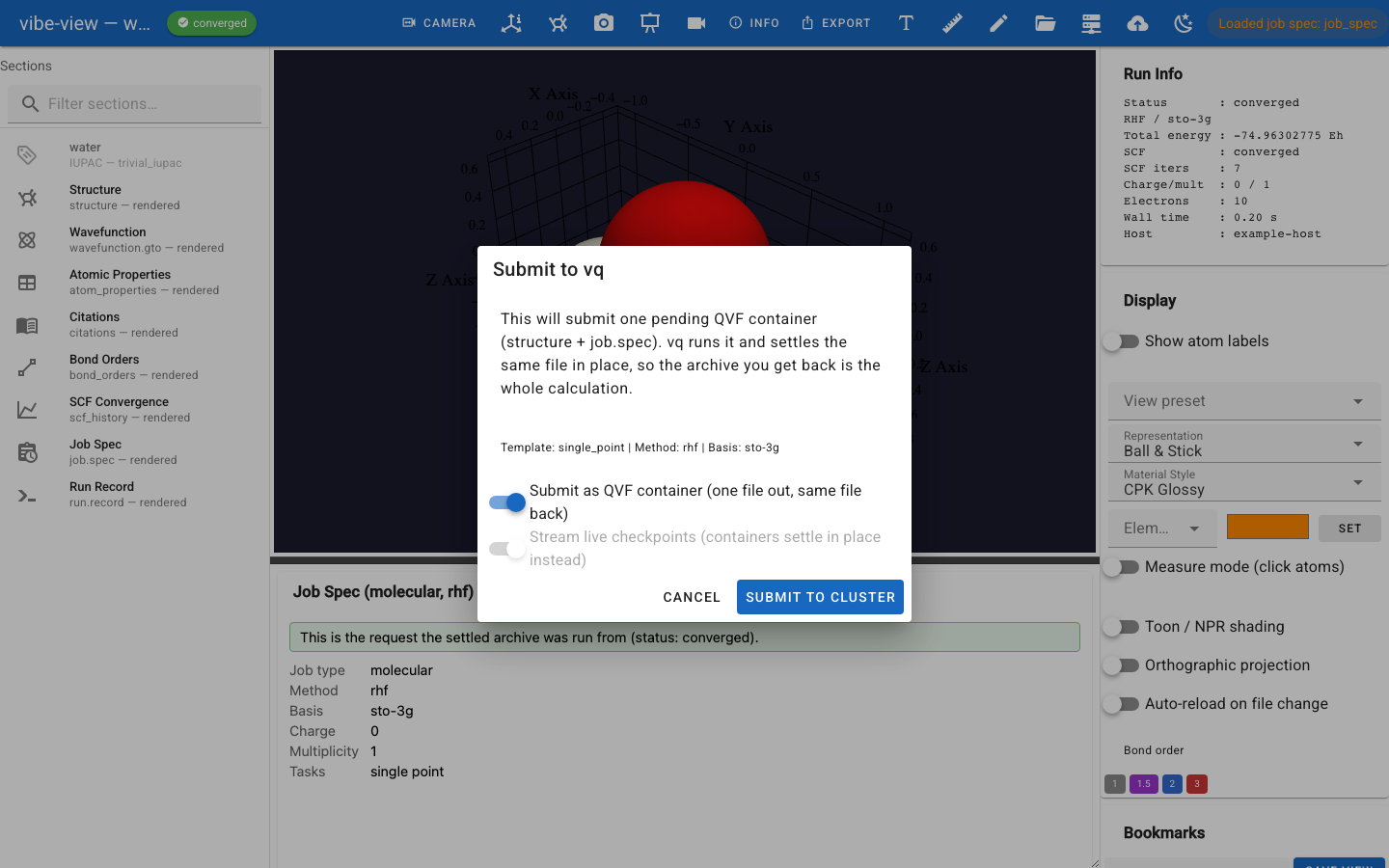
The submit dialog, with the container switch on.
QVF containers
Leave Submit as QVF container on and the payload is a single pending
archive instead of a generated script: the structure on screen plus a
job.spec section (method, basis, functional, charge, multiplicity), with
its run status set to pending. The queue recognizes the suffix and runs
the container in place: results, the full log, the citations and the system
manifest all land inside the same file, and its status becomes converged
or failed. The Job Manager’s open action then loads that settled archive
with its Job Spec and Run Info panels intact.
Why you would want it: the request travels with the numbers, so a result
is reproducible from the file alone; one file moves each way instead of a
directory; and nothing has to be reassembled from sidecars afterwards. The
job.spec payload is declarative data, never code: running a container
never executes an embedded script.
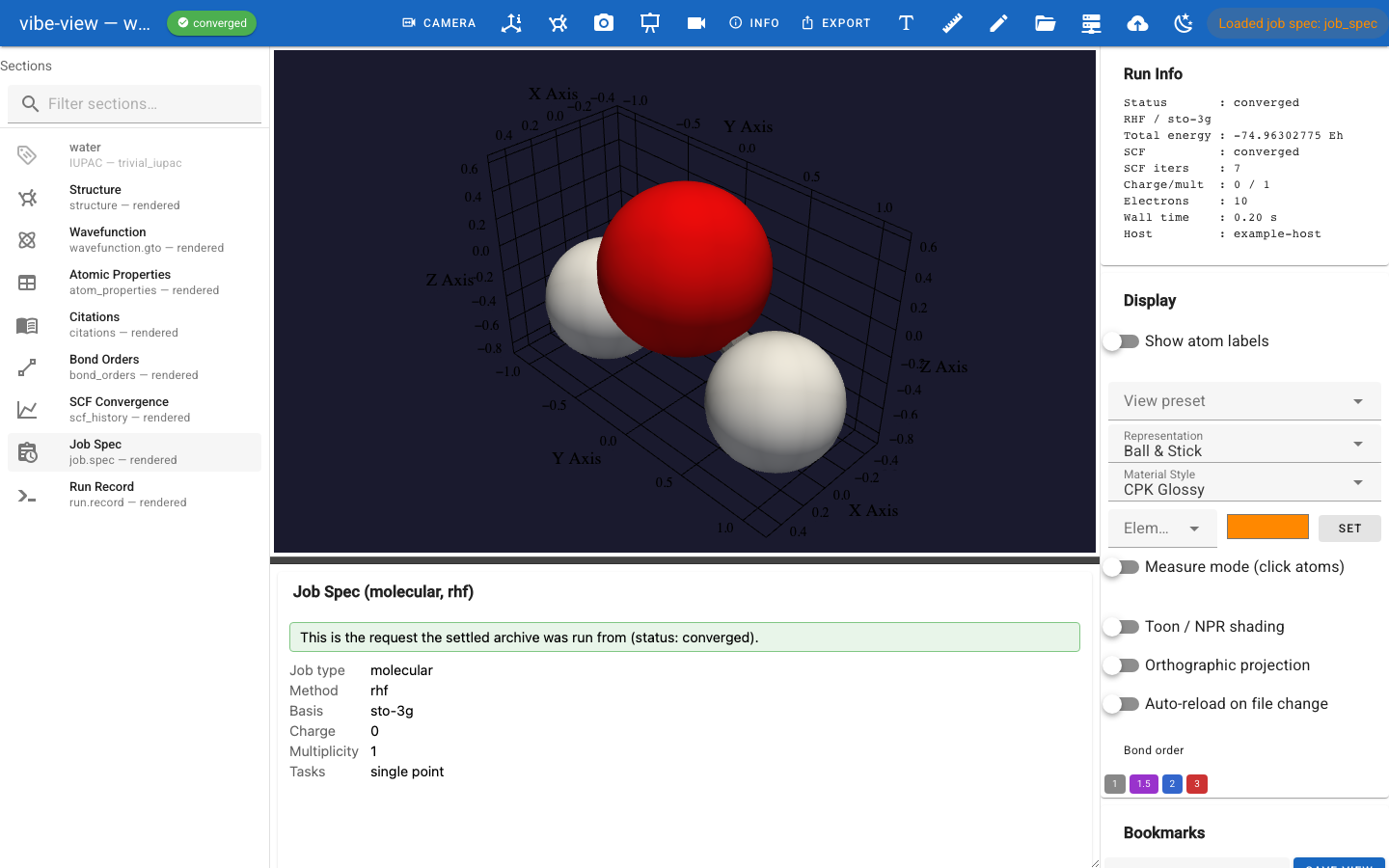
The same container after it ran: results, the executed spec and the log, in one file.
This is the one place vibe-qc matters. Writing a pending archive is a producer action, and the viewer does not depend on the producer, so the switch is disabled when vibe-qc is not importable next to vibe-view; the viewer then submits its generated script and says so in the status line. Streaming checkpoints is a script-mode option; a container settles in place instead of emitting a separate checkpoint file.
A container opens like any other archive, in every surface: a pending one
shows an amber chip and a Job Spec panel saying it has not run yet; with
auto-reload on, the chip follows the file through running to its terminal
state. vibe-view show job.qvf --info prints the lifecycle without a
display.
From Python
The watcher is importable for your own scripts:
from vibeview.file_watcher import QVFChangeTracker, watch_qvf

# Synchronous: poll from your own loop.
tracker = QVFChangeTracker("job.qvf")           # settle_delay=0.5
event = tracker.poll()                          # a QVFChange, or None
if event:
    print(event.changed_sections, event.added_sections, event.removed_sections)

# Or a background thread with callbacks.
watcher = watch_qvf("job.qvf", on_reload, interval=5.0,
                    on_event=lambda ev: print(ev.changed_sections))
watcher.stop()
A QVFChange carries the changed, added and removed section ids,
manifest_meta_changed (true when a non-section manifest key moved, such as
a streaming job’s status flipping to converged) and is_qvf (false for a
file tracked by whole-file hash because it is not a parseable archive).
The streaming provenance is on the reader:
from vibeview import QVFReader

r = QVFReader("checkpoint.qvf")
r.run_status                    # "running" | "converged" | "failed" | None
r.checkpoint_info               # {"seq": ..., "wall_time_s": ..., ...}
r.section_is_partial("traj0")   # True while the producer is still growing it
Both are below the supported vibeview.__all__ surface; pin the version
you script against.