Annotate mechanisms and connect reaction steps
A straight reaction arrow defines a reaction step. A curved arrow records electron movement in the drawing. They have different meanings in the properties panel, and neither runs a reaction-path calculation.
Follow a two-step scheme
Open two-step.vsk. The first step is Diels–Alder cycloaddition of butadiene and ethene. The second is addition of hydrogen to the resulting cyclohexene, giving cyclohexane. The shared cyclohexene connects the two reactions.
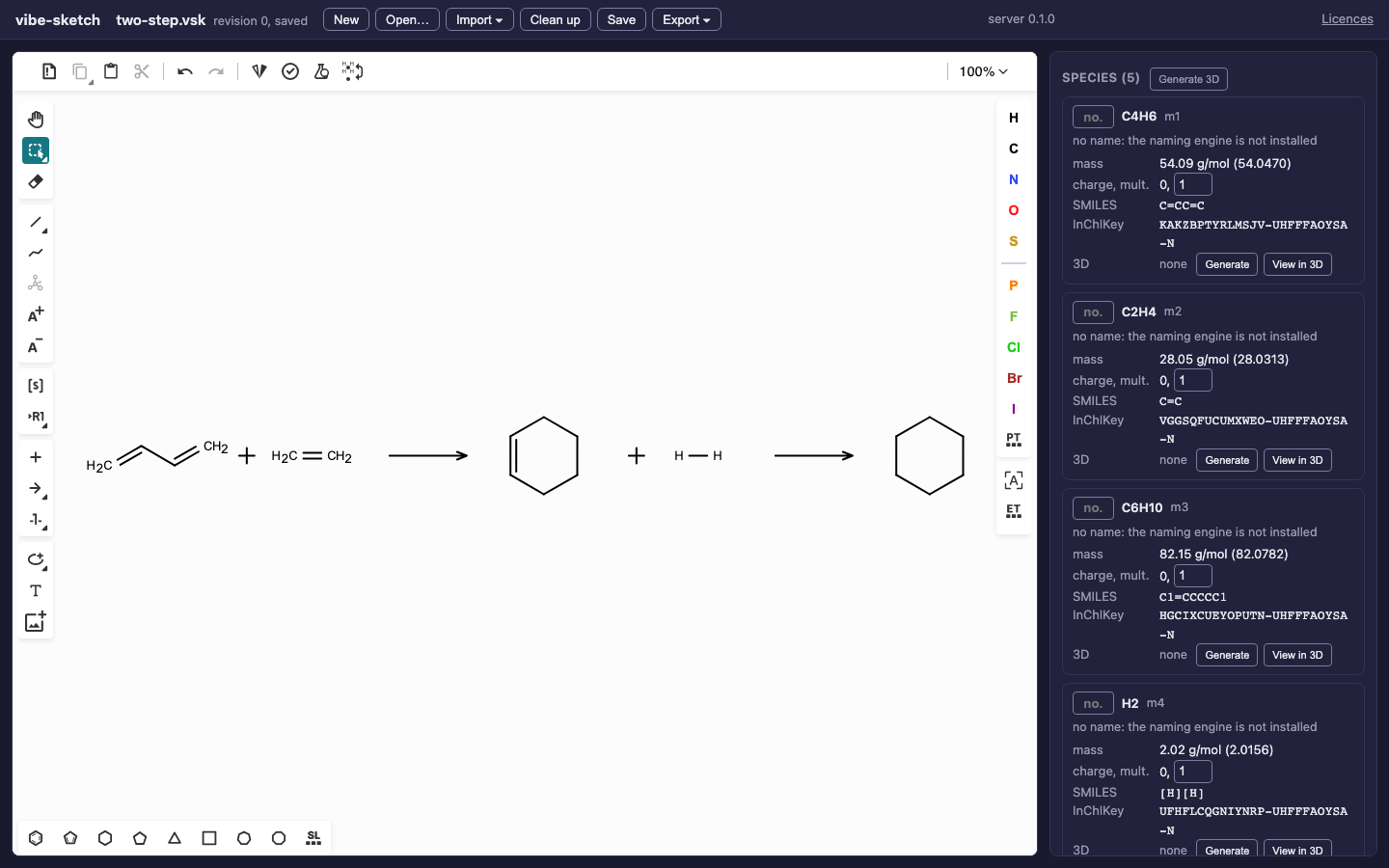
The document has two reactions and five unique species. Inspect each step’s reactants and products, rather than treating all molecules as one reaction.
Match each straight arrow to a reaction card. Step one has two reactants; step two has cyclohexene plus H2. The final product is C6H12.
Add supported condition text using T above the appropriate arrow. Text such as
Ni catalystis a condition annotation, not a nickel species.Use plus signs to group molecules on one side of an arrow. A separate molecule placed beside the arrow can be interpreted as a reagent. Inspect the resulting roles after every move.
Move or rotate whole fragments using the selection tools. With multiple arrows, the nearest connected molecules and plus groups determine each step.
Save QVF/VSK. Try RXN export: it is refused because RXN holds one reaction. Export individual steps separately if that is what the destination requires.
Draw electron-pushing annotations
For the Diels–Alder reactants, first arrange the diene in an s-cis conformation and the alkene facing it. Expand the arrow palette and choose a curved arrow with a full head for an electron pair. Draw the three concerted movements from a π bond towards a new σ bond, from the alkene π bond towards the other new σ bond, and from the remaining diene π bond towards the new internal π bond. Each tail should begin at the donating bond. Use Undo to correct a misplaced arrow. This is a concerted cycloaddition illustration; it should not introduce an isolated carbocation intermediate.
The palette also offers a half-headed curved arrow for a single electron. Use that only when illustrating a radical electron movement. The methyl-radical worksheet supplies a radical structure for practising the tool; one fishhook alone is not a complete reaction mechanism.
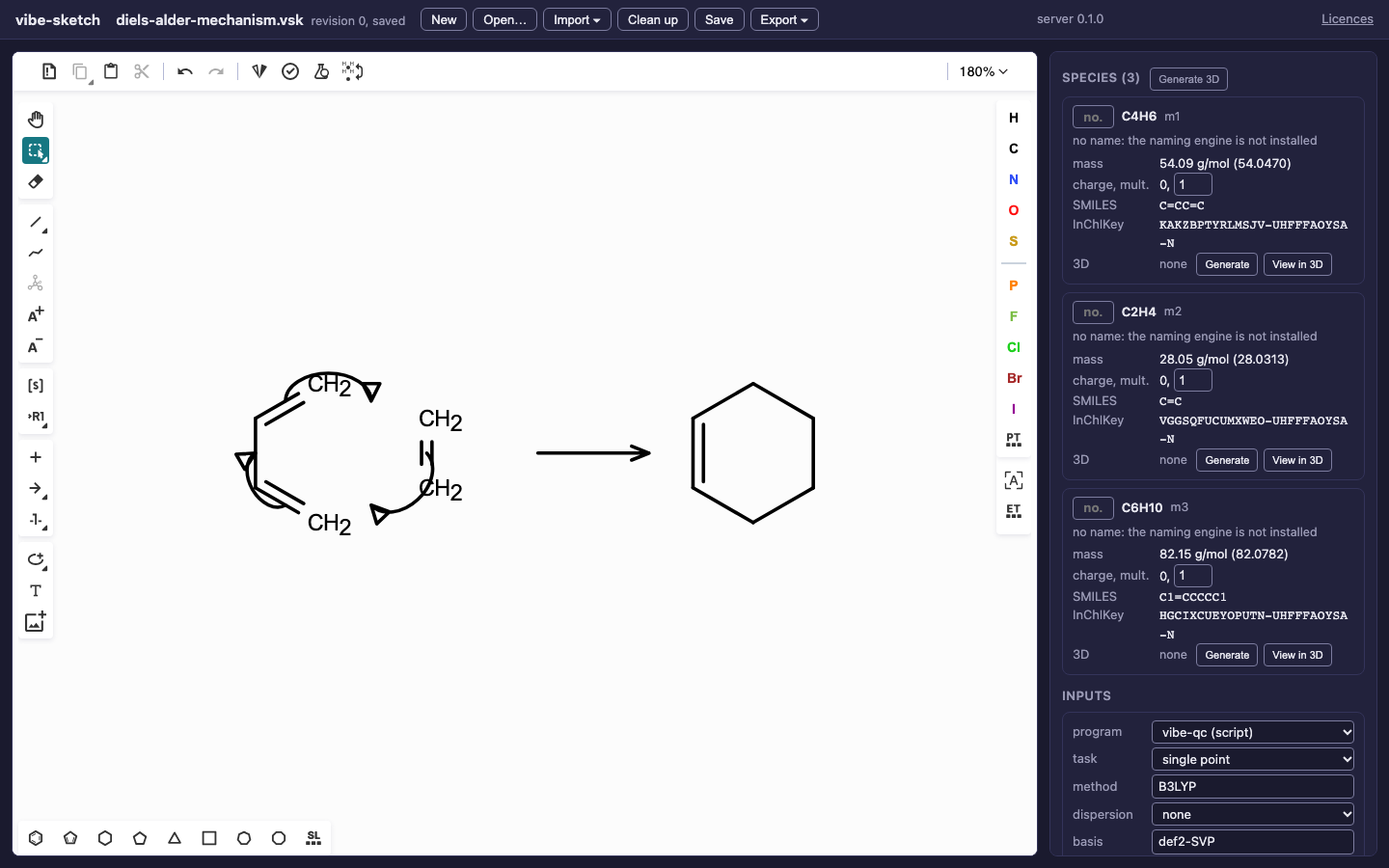
The editable mechanism contains three electron-pair arrows and one straight reaction arrow. Only the straight arrow creates a reaction in the panel.
Curved arrows, crossed-out arrows, R-groups and polymer annotations remain in KET/QVF/VSK. Curved arrows are not additional reaction steps. Structures that cannot be interpreted as a definite molecule appear under Notes; they are not invented as computable species. Current SVG export composes interpreted species and reactions, so it is not a faithful mechanism-canvas export. Preserve the editable drawing and inspect any exported figure.
Try another named reaction
Open suzuki.vsk: bromobenzene and phenylboronic acid form biphenyl in a Suzuki coupling. The Nobel lecture provides background on organoboron cross-coupling.
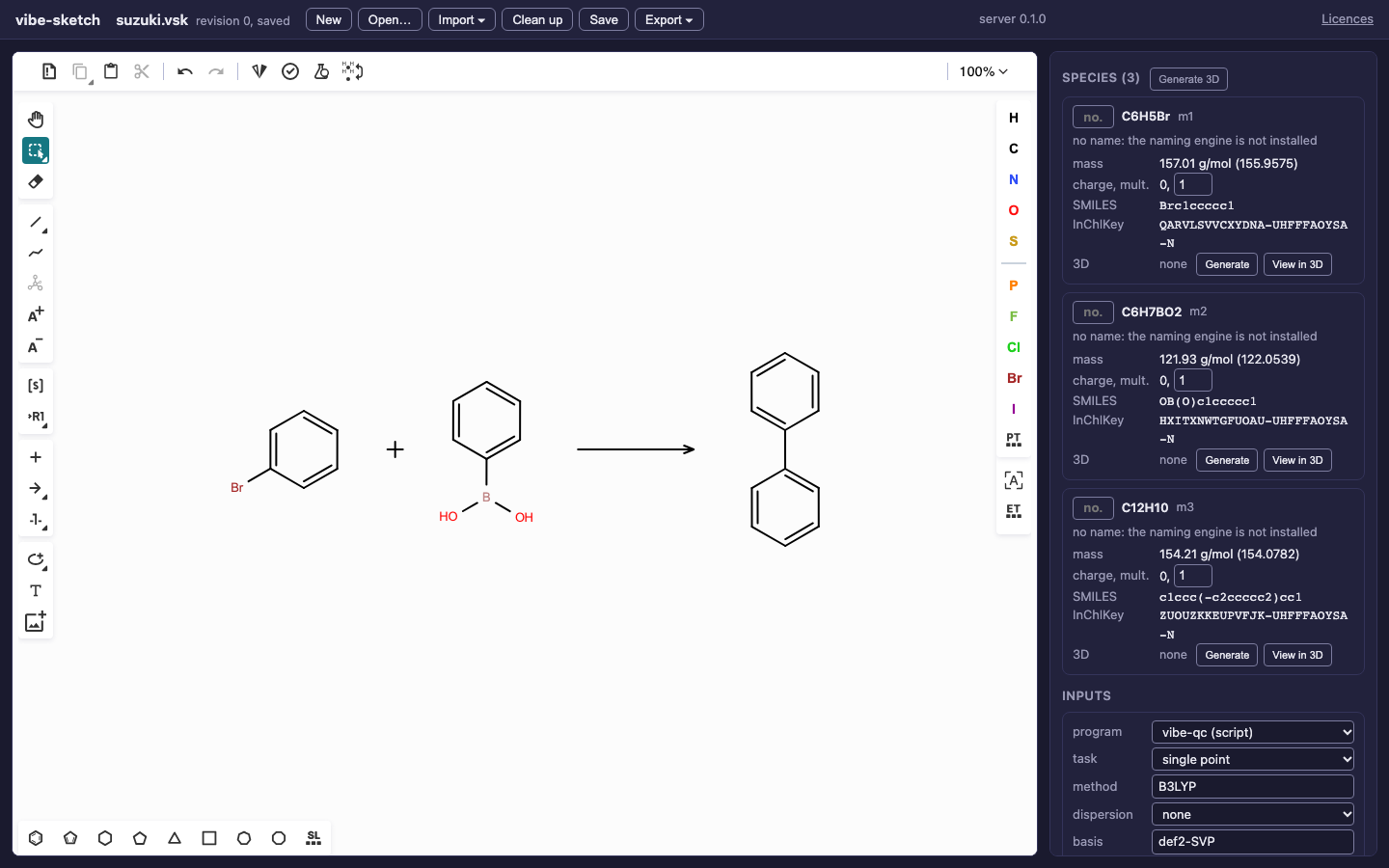
An organic-component drawing example. It omits inorganic coproducts, catalyst and base, and asserts no yield or experimental conditions.
Use this for ring templates, the periodic table, functional groups and compound numbers. Do not compute a balanced reaction energy from this organic-only scheme. Likewise, text catalysts and reagents do not silently become atoms in a quantum calculation.