Portable geometry and optional ORCA inputs
The main calculation walkthrough uses vibe-qc. This page covers the remaining writers with the same lactic-acid-3d.vsk starting geometry. No ORCA installation is needed to write an input. Running it requires your separately installed ORCA program.
Write XYZ and QCSchema
vibe-sketch input lactic-acid-3d.vsk --species m1 --program xyz --output-dir xyz
vibe-sketch input lactic-acid-3d.vsk --species m1 --program qcschema-molecule --output-dir molecule
vibe-sketch input lactic-acid-3d.vsk --species m1 --program qcschema \
  --task sp --method HF --basis def2-SVP --output-dir energy
vibe-sketch input lactic-acid-3d.vsk --species m1 --program qcschema \
  --task freq --method HF --basis def2-SVP --output-dir hessian
XYZ uses angstrom and records charge/multiplicity in the comment. The
QCSchema molecule uses schema version 2 and bohr. The QCSchema input uses
schema version 1, an energy or HF hessian driver, and empty keywords.
Check units before reading coordinates in another program. These writers
use the first conformer.
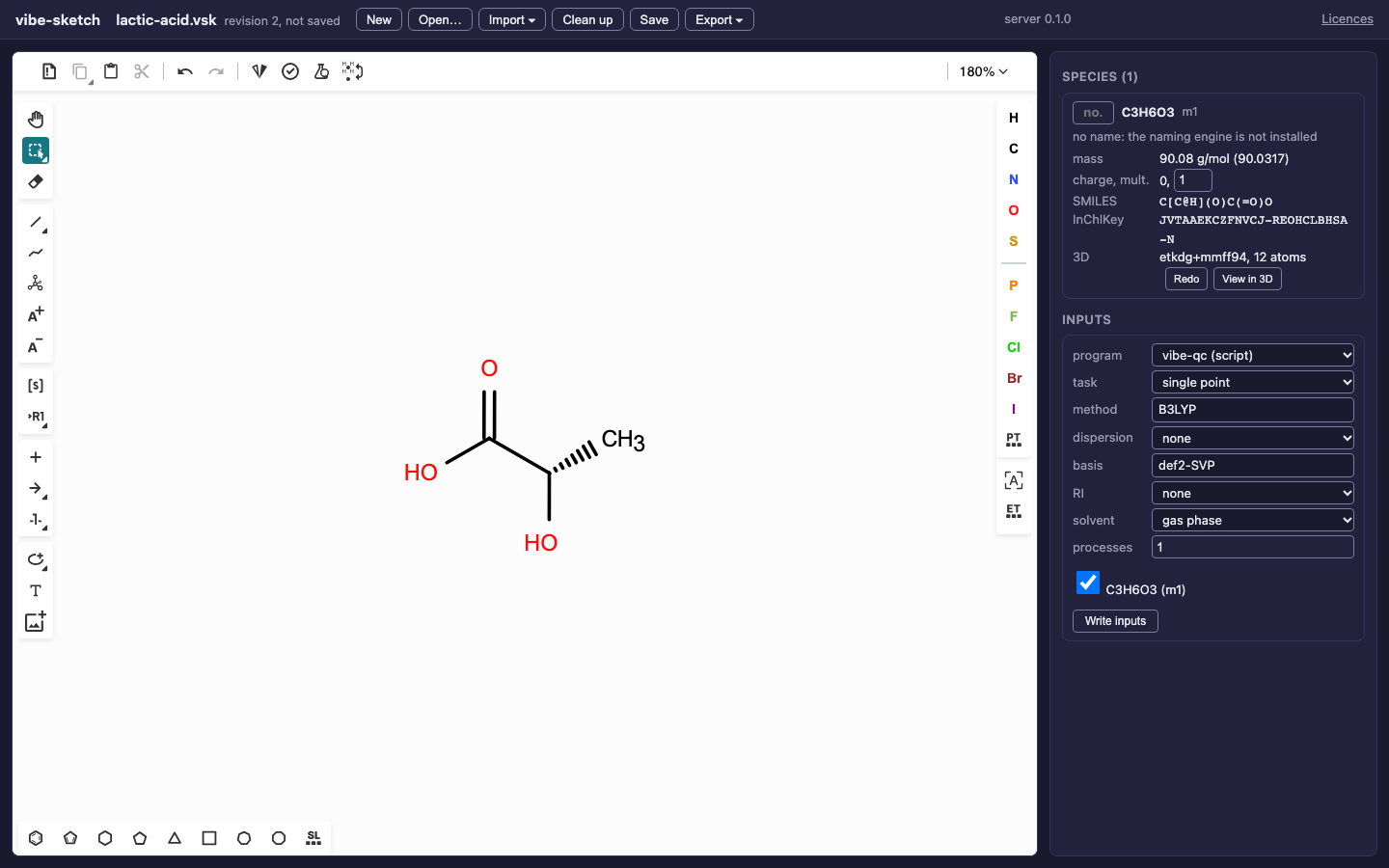
The shared source geometry. The generated XYZ and JSON are in the example archive.
XYZ and qcschema-molecule are geometry-only and refuse a calculation spec.
QCSchema refuses optimisation, TDDFT, NMR and unsupported keyword fields;
it does not translate them into an unrelated driver. The
generator writes both geometry
formats, both QCSchema tasks and checked refusal examples.
Write and inspect an ORCA input
In Inputs, select ORCA, B3LYP/def2-SVP, and NMR. Write inputs
produces an .inp file. This screenshot deliberately shows the optional
ORCA workflow; the other calculation tutorials use vibe-qc.
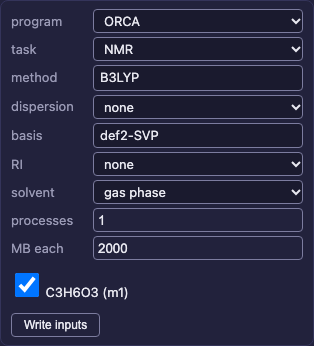
A generated ORCA NMR input, not an executed ORCA calculation.
The archive contains examples for
all six ORCA tasks: sp, opt, freq, opt+freq, tddft and nmr.
inputs/orca/options/spec.json adds D3BJ, def2-TZVP, def2/J, RIJCOSX,
SMD water, two processes, 1000 MB per core and a frozen position:
vibe-sketch input lactic-acid-3d.vsk --species m1 --program orca \
  --spec inputs/orca/options/spec.json --output-dir orca-options
Inspect the keyword line, %pal, %maxcore, solvation/TDDFT/constraint
blocks and the * xyz charge multiplicity geometry. ORCA constraints can
also specify distances, angles and dihedrals through JSON, with zero-based
atom indices; inputs/orca/internal-constraints/ exercises all three. A missing constraint value uses its starting value; a position
constraint has no value.
Consult the exact option table before changing methods. Composite methods carry their own basis/approximations. RI-MP2 and DLPNO need appropriate correlation-fitting bases. Some method/task combinations, duplicate dispersion choices and missing auxiliary bases are refused. These checks deliberately prevent unsupported inputs from being guessed.