Generate every supported vibe-qc task
Prepare lactic-acid-3d.vsk, then open Inputs in the right-hand panel. Select vibe-qc, the species and the desired task. This exercise writes inputs; execution requires a separate vibe-qc installation, directly or through vq.
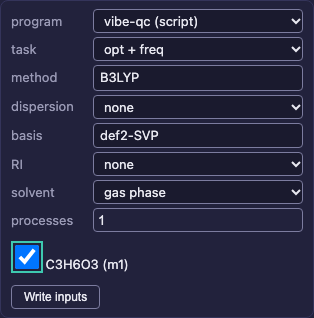
The illustrated workflow writes a vibe-qc optimisation and frequency script. It is not a screenshot of a completed optimisation.
Choose the calculation
Run the generator, or unpack the
example archive. Under
inputs/vibeqc/, each task has a spec.json and generated Python input.
Inspect the specification and script together.
Task |
Try |
What it requests |
|---|---|---|
|
B3LYP/def2-SVP |
Energy and properties at the supplied geometry. |
|
The same method and basis |
Geometry optimisation. |
|
The same method and basis |
A finite-difference Hessian for supported HF/DFT. Check whether the starting geometry is stationary. |
|
The same method and basis |
Optimise, then compute the Hessian. |
|
Set |
Full TDDFT excited states, rather than TDA. |
For example:
vibe-sketch input lactic-acid-3d.vsk --species m1 --program vibeqc \
  --task tddft --states 3 --method B3LYP --basis def2-SVP --output-dir excited
These small inputs demonstrate the writer contract, not a recommended
production level of theory for every system. Run the generated .py with
the Python belonging to your vibe-qc installation. It requests QVF and Molden
outputs. The reaction workflow shows real
completed jobs and result retrieval.
Set options explicitly
The generated inputs/vibeqc/options/spec.json exercises D3BJ, RIJCOSX,
a compatible fitting basis, CPCM water, two threads and one frozen atom.
Use it from the CLI:
vibe-sketch input lactic-acid-3d.vsk --species m1 --program vibeqc \
  --spec inputs/vibeqc/options/spec.json --output-dir constrained
Option family |
Where to set it |
Check in the output |
|---|---|---|
Method and orbital basis |
Inputs form or |
HF becomes RHF/UHF; DFT becomes RKS/UKS with the named functional. |
Dispersion |
Inputs form or |
D3BJ or D4; D4 execution needs vibe-qc’s optional support. |
RI and auxiliary basis |
RI control, or |
RIJCOSX enables density fitting and COSX. A supplied auxiliary basis must be one vibe-qc supports. |
Solvent |
CPCM control or |
The selected preset; SMD is refused by the vibe-qc writer. |
Resources |
Processes or |
|
Frozen positions |
JSON |
|
Do not copy an ORCA auxiliary-basis spelling into a vibe-qc specification
without checking the writer reference. The example uses
def2-tzvp-jk for vibe-qc and def2/J for the optional ORCA writer.
Constraints apply to optimisation tasks. Atom indices refer to the exported
conformer, with drawing atoms followed by added hydrogens; inspect the XYZ
before choosing them.
Write a reaction batch
Open diels-alder-3d.vsk. Select vibe-qc, single point, B3LYP and def2-SVP. Tick the three species and select Write inputs. The download is a ZIP containing three scripts.
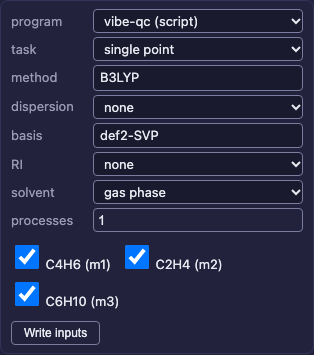
Select a subset by clearing species checkboxes. This is one calculation per species, not a reaction-path calculation.
--all selects every species; repeated --species selects a subset.
The generator also creates lactic-acid-job.vsk with job j1, which you can
write using vibe-sketch input lactic-acid-job.vsk --job j1.
Writers use the first conformer only.
Read a refusal
Choose NMR while vibe-qc is selected and press Write inputs. The writer refuses: vibe-qc has no supported NMR shielding task. Change to a supported task before trying again. Do not substitute a different keyword silently.
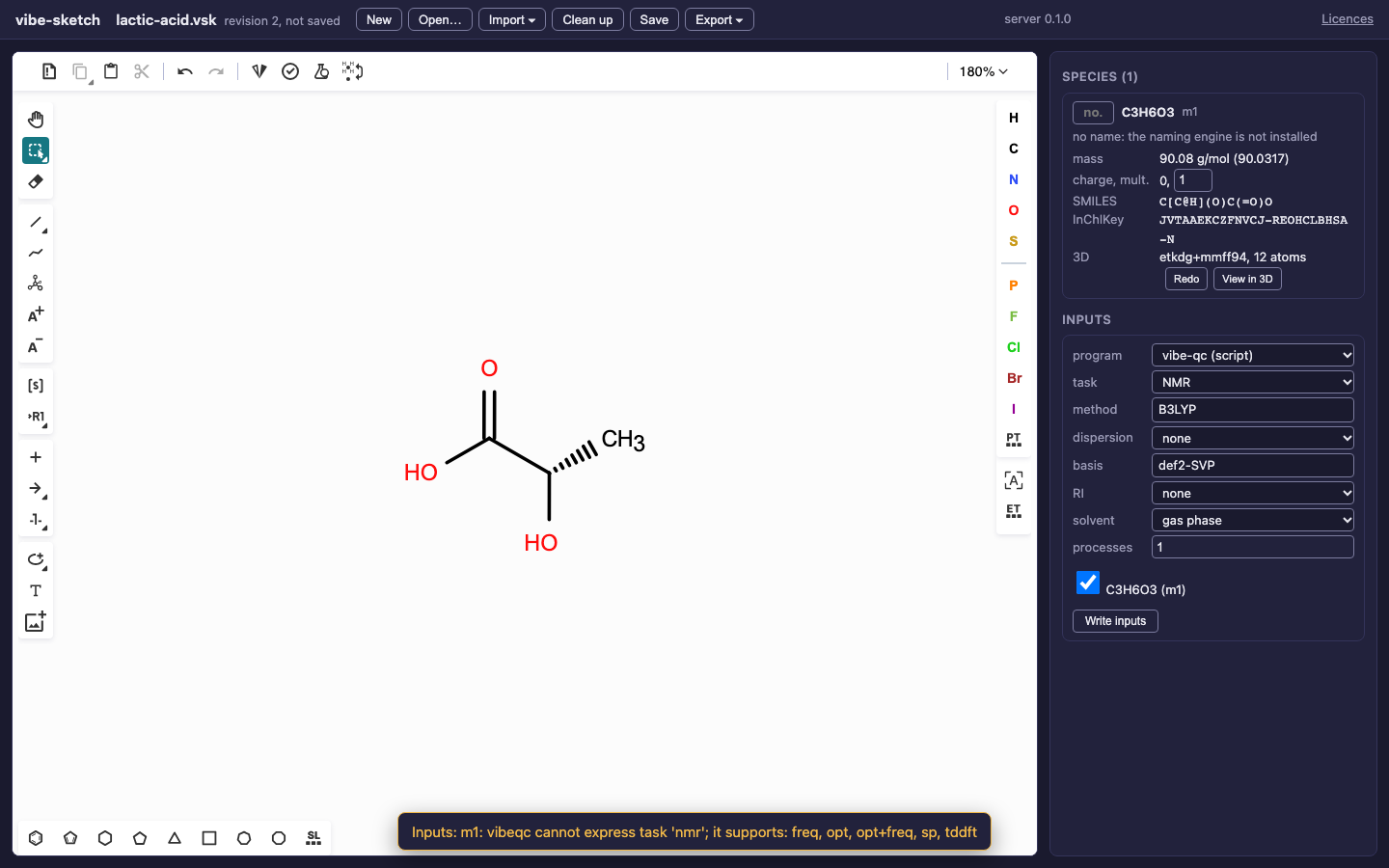
A refusal is an explicit unsupported request, not a completed input or calculation.
The archive’s refusals.json also records geometry-writer and QCSchema task
refusals. In batches, supported species can still produce files while refused
species are listed in REFUSED.txt; CLI exit status 3 signals a partial
refusal. Check the report before submitting. Unknown job/species/writer names
are usage errors, with exit status 2.