Crystal lattices
A crystal is a lattice plus a basis: an infinite, periodic
arrangement of points where each point carries one or more atoms.
Every periodic calculation in vibe-qc, PeriodicSystem,
run_rhf_periodic_scf, monkhorst_pack, band-structure plots,
starts from one of the 14 Bravais lattices, decorated with the
basis atoms that turn it into a real material.
This page is the reference for which lattice to pick, how to set it up in vibe-qc, and what the Brillouin zone of each looks like. For the sampling of the BZ (Monkhorst-Pack, Monkhorst, Hendrik J. and Pack, James D. (1976). *Special points for Brillouin-zone integrations.* Physical Review B, **13**(12), 5188–5192. doi:[10.1103/PhysRevB.13.5188](https://doi.org/10.1103/PhysRevB.13.5188); IBZ reduction, mesh choice, band paths), see k-point meshes.
Lattice + basis = crystal
A Bravais lattice is the set of points
where the lattice vectors \(\mathbf{a}_1, \mathbf{a}_2, \mathbf{a}_3\) define the parallelepiped unit cell. The basis is the list of atoms inside one unit cell:
The full crystal is then \(\{\boldsymbol\tau_j + \mathbf{R}\}\) for every \(\mathbf{R}\) on the lattice and every atom \(j\) in the basis.
Every Bravais lattice has a single point per unit cell. Crystals with 2+ atoms per cell are not multi-atom Bravais lattices, they’re a Bravais lattice with a multi-atom basis. Diamond is FCC + 2-atom basis; NaCl is FCC + 2-atom basis; HCP is hexagonal + 2-atom basis.
In vibe-qc:
import numpy as np
import vibeqc as vq

# 1. The three lattice vectors, in bohr. Give them as VECTORS
#    (``lattice_vectors=``): vibe-qc stacks them into the COLUMNS of the
#    lattice matrix for you. The ``lattice=`` matrix form reads columns
#    too, so a row-major literal handed to it is silently transposed --
#    harmless on this cubic cell, a different crystal on a hexagonal or
#    monoclinic one (issue #445; see periodic_systems.md).
a = 4.12 / 0.529177210903   # CsCl cubic edge, Angstrom -> bohr
a1 = [a, 0.0, 0.0]
a2 = [0.0, a, 0.0]
a3 = [0.0, 0.0, a]

# 2. Basis atoms in CARTESIAN bohr (``Atom`` never takes fractional
#    coordinates): Cs at the corner, Cl at the body centre (a/2, a/2, a/2).
#    This is CsCl, simple cubic + 2-atom basis (NaCl needs the FCC
#    lattice; see Rocksalt below).
sysp = vq.PeriodicSystem(
    dim=3,
    lattice_vectors=[a1, a2, a3],
    unit_cell=[
        vq.Atom(55, [0.0, 0.0, 0.0]),
        vq.Atom(17, [a / 2, a / 2, a / 2]),
    ],
)
vq.cell_parameters(sysp)      # a = b = c = 7.786 bohr, alpha = beta = gamma = 90
The lattice vectors, the choice of which atom sits at the origin,
and the orientation are all conventions. Different choices are
equivalent if related by a lattice translation; always physically
equivalent if related by a point-group operation.
The 14 Bravais lattices
The Bravais classification groups every possible periodic 3D lattice into 14 types, organized under the 7 crystal systems:
# |
Crystal system |
Bravais lattices |
Constraint on \(a, b, c\) |
Constraint on \(\alpha, \beta, \gamma\) |
|---|---|---|---|---|
1 |
Triclinic |
aP |
none |
none |
2 |
Monoclinic |
mP, mC (or mB) |
none |
\(\alpha = \gamma = 90°\), \(\beta \neq 90°\) |
3 |
Orthorhombic |
oP, oC, oI, oF |
none |
\(\alpha = \beta = \gamma = 90°\) |
4 |
Tetragonal |
tP, tI |
\(a = b \neq c\) |
\(\alpha = \beta = \gamma = 90°\) |
5 |
Trigonal (rhombohedral) |
hR |
\(a = b = c\) |
\(\alpha = \beta = \gamma \neq 90°\) |
6 |
Hexagonal |
hP |
\(a = b \neq c\) |
\(\alpha = \beta = 90°\), \(\gamma = 120°\) |
7 |
Cubic |
cP, cI, cF |
\(a = b = c\) |
\(\alpha = \beta = \gamma = 90°\) |
Letter codes: P = primitive, I = body-centered, F = face- centered, C (or A, B) = base-centered (one face), R = rhombohedral primitive.
The 14 unique lattices are:
Cubic:           cP    cI (BCC)    cF (FCC)
Tetragonal:      tP    tI
Orthorhombic:    oP    oC          oI            oF
Hexagonal:       hP
Trigonal:        hR
Monoclinic:      mP    mC
Triclinic:       aP
Why 14 and not (say) 7 × 4 = 28? Some centrings are equivalent to other Bravais lattices under a different choice of axes, e.g. “face-centered tetragonal” is the same as “body-centered tetragonal” with a 45° in-plane rotation.
Important
Periodic electronic-structure methods in vibe-qc must accept every
full-rank 3D lattice matrix from the 7 crystal systems. The centering
letters (P, I, F, C, R) are represented either by primitive
lattice vectors or by additional basis atoms in a conventional cell;
they are not special cases in the Coulomb, GDF, FFT, k-point, or SCF
interfaces. Regression tests cover representative triclinic,
monoclinic, orthorhombic, tetragonal, trigonal, hexagonal, and cubic
metrics.
Note
The Bravais classification covers only point groups of the lattice. The full classification of crystals (which adds the basis
point-group symmetries) gives the 230 space groups, of which the 14 Bravais lattices are the translational backbone. vibe-qc uses spglib (Togo, Atsushi, Shinohara, Kohei, and Tanaka, Isao (2024). *Spglib: a software library for crystal symmetry search.* Science and Technology of Advanced Materials: Methods, **4**(1), 2384822. doi:[10.1080/27660400.2024.2384822](https://doi.org/10.1080/27660400.2024.2384822)) to identify the space group of a
PeriodicSystem—attach_symmetry(sysp)returns the spglib classification + the symmetry operations.
Common materials lattices
Most QC use cases reduce to a small list of Bravais lattices with
specific basis decorations. Below: the name, primitive lattice
vectors (listed one per row in units of the lattice constant \(a\);
hand them to lattice_vectors= as written, or stack them into the
columns of the lattice= matrix), and basis (in fractional
coordinates of the primitive lattice; convert to Cartesian bohr
before building Atoms). Each entry includes a visualisation (cell + 2×2×2
supercell, rotated for clarity) and links to worked examples
under examples/periodic/<system>/.
Worked examples by material class
The bundled examples/periodic/ directory ships standalone input
scripts (RHF + RKS-PBE + RKS-B3LYP for each material) plus
.system provenance manifests and, for MgO, paired CRYSTAL14
parity inputs. Use this index to find an example matching the
lattice and chemistry you’re targeting:
Class |
Materials |
Example directories |
|---|---|---|
Ionic, alkali / alkaline-earth halides + oxides |
LiH, NaCl, MgO |
|
Ionic, transition-metal oxides + wide-gap insulators |
TiO₂, ZnO, Al₂O₃, SiO₂ |
TiO2-rutile, ZnO-wurtzite, Al2O3-corundum, SiO2-alpha-quartz |
Semiconductors |
C-diamond, Si-diamond |
|
Noble-gas solids |
Ne FCC |
|
Metals |
- |
Open at v0.8.x, see the metals note below. |
Note
Metals: Fermi-Dirac smearing is available
(run_periodic_job(..., smearing_temperature="0.01 Ha"), see
smearing), and the multi-k GDF drivers run any
Monkhorst-Pack mesh (see multi_k_scf.md). True
metallic convergence needs a dense k-mesh, and a production
metals example doesn’t ship yet. The metal-lattice visualisations
below are correct; the example inputs slot is intentionally
empty.
Inline-example shortcut: MgO rocksalt
One full example inline so this page is self-contained, MgO
rocksalt at the conventional 8-atom cell, Γ-only RHF / sto-3g,
matching examples/periodic/MgO-rocksalt/MgO-rocksalt-RHF-sto3g.py:
"""MgO rocksalt — Γ-only native GDF RHF.

Run::
    .venv/bin/python this_file.py
"""
import numpy as np
from vibeqc import Atom, BasisSet, PeriodicSystem, run_periodic_job

ANG2BOHR = 1.0 / 0.529177210903
a_ang = 4.211  # MgO experimental lattice constant (Å)

# Conventional cubic cell, 8 atoms (4 MgO formula units).
cell_bohr = np.eye(3) * a_ang * ANG2BOHR

atoms = [
    # Mg at the corner and face centres (FCC sublattice)
    Atom(12, [0.0, 0.0, 0.0]),
    Atom(12, [0.0, a_ang/2, a_ang/2]),
    Atom(12, [a_ang/2, 0.0, a_ang/2]),
    Atom(12, [a_ang/2, a_ang/2, 0.0]),
    # O at the body centre and edge centres (interpenetrating FCC, offset by ½ diagonal)
    Atom(8, [a_ang/2, a_ang/2, a_ang/2]),
    Atom(8, [a_ang/2, 0.0, 0.0]),
    Atom(8, [0.0, a_ang/2, 0.0]),
    Atom(8, [0.0, 0.0, a_ang/2]),
]
atoms = [Atom(a.Z, [c * ANG2BOHR for c in a.xyz]) for a in atoms]
system = PeriodicSystem(3, cell_bohr, atoms)
basis = BasisSet(system.unit_cell_molecule(), "sto-3g")

result = run_periodic_job(
    system, basis=basis,
    method="RHF",
    output="MgO-rocksalt-RHF-sto3g",
)
print(f"E = {result.energy:.6f} Ha/cell")
# Reference (v0.9.0 native GDF, sub-µHa vs PySCF.pbc.GDF):
# E ≈ -274.4321 Ha (RHF / sto-3g / Γ)
Every other lattice has the equivalent script under
examples/periodic/<material>/; the inline example is a
representative case to read top-to-bottom without leaving the
docs.
Cubic family
Simple cubic (cP)
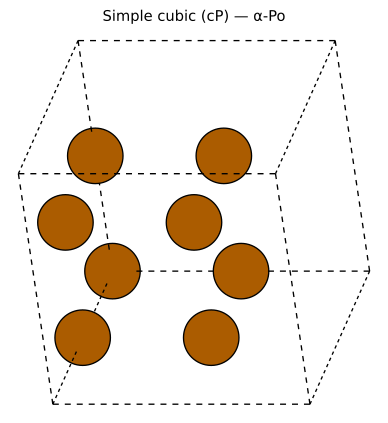
The textbook lattice, corners of a cube, one atom per cell.
a₁ = (a, 0, 0)
a₂ = (0, a, 0)
a₃ = (0, 0, a)

Basis: (0, 0, 0)
Real materials: α-polonium is the only stable elemental simple-cubic solid at ambient conditions. A useful toy model for periodic SCF testing, large, isotropic, easy to converge.
a = 6.35  # bohr (alpha-Po, a = 3.36 Å)
sysp = vq.PeriodicSystem(
    dim=3,
    lattice=a * np.eye(3),
    unit_cell=[vq.Atom(84, [0.0, 0.0, 0.0])],   # Po
)
Body-centered cubic / BCC (cI)
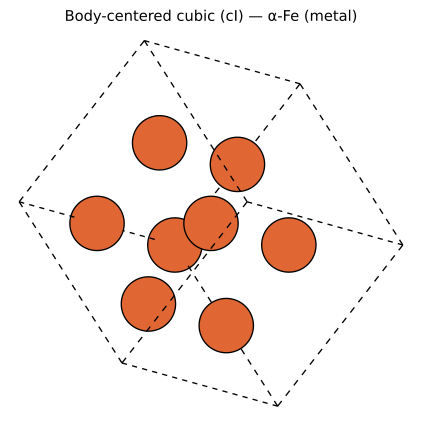
Conventional cubic cell with extra atom at the body center. The primitive cell is a rhombohedron one-half the volume of the conventional cubic cell.
Conventional cubic (2-atom basis):
  a₁ = (a, 0, 0); a₂ = (0, a, 0); a₃ = (0, 0, a)
  Basis: (0, 0, 0), (½, ½, ½)

Primitive (1-atom basis):
  a₁ = (a/2)·(-1,  1,  1)
  a₂ = (a/2)·( 1, -1,  1)
  a₃ = (a/2)·( 1,  1, -1)
  Basis: (0, 0, 0)
Real materials: α-Fe (2.87 Å), Na, K, Cr, Mo, W, V, Nb, Ta, many transition metals and alkali metals. Metal-typical; needs dense k-mesh + Fermi-Dirac smearing in production. See the metals note above.
Face-centered cubic / FCC (cF)
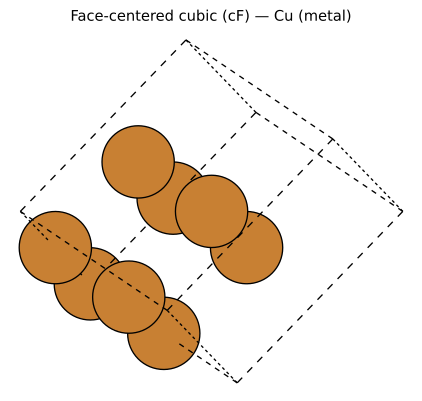
Conventional cubic cell with atoms at the corners + face centers. 4 conventional-cell atoms, primitive cell is one quarter the volume.
Conventional cubic (4-atom basis):
  a₁ = (a, 0, 0); a₂ = (0, a, 0); a₃ = (0, 0, a)
  Basis: (0, 0, 0), (½, ½, 0), (½, 0, ½), (0, ½, ½)

Primitive (1-atom basis):
  a₁ = (a/2)·(0, 1, 1)
  a₂ = (a/2)·(1, 0, 1)
  a₃ = (a/2)·(1, 1, 0)
  Basis: (0, 0, 0)
Real materials: Cu, Ag, Au, Al, Ni, Pt, Pd, γ-Fe, Pb, most
ductile FCC metals plus the noble metals. Metal-typical (see
the metals note). Closed-shell noble-gas FCC
solids (Ne, Ar) work today at Γ-only, see
examples/periodic/Ne-fcc/.
Diamond / zincblende (cF + 2-atom basis)
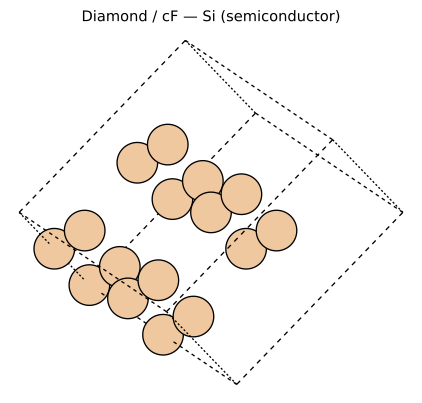
FCC primitive lattice + 2-atom basis at \((0,0,0)\) and \((¼,¼,¼)\). Same for diamond (both atoms = C), zincblende (one Zn, one S), GaAs (Ga + As), AlP, BN cubic, etc.
Primitive (FCC):
  a₁ = (a/2)·(0, 1, 1)
  a₂ = (a/2)·(1, 0, 1)
  a₃ = (a/2)·(1, 1, 0)
  Basis: (0, 0, 0), (¼, ¼, ¼)
a = 10.26  # bohr (Si)
sysp = vq.PeriodicSystem(
    dim=3,
    lattice_vectors=(a / 2) * np.array([   # FCC primitive vectors, one per row
        [0, 1, 1],
        [1, 0, 1],
        [1, 1, 0],
    ]),
    unit_cell=[
        vq.Atom(14, [0.00, 0.00, 0.00]),          # Si at primitive-cell origin
        vq.Atom(14, [a / 4, a / 4, a / 4]),       # Si at fractional (1/4,1/4,1/4), Cartesian bohr
    ],
)
Real materials (semiconductor lattice): diamond (C, a = 6.74 bohr), Si (a = 10.26 bohr), Ge (a = 10.69 bohr); zincblende ZnS, GaAs, InP, InSb, AlP, AlAs, BN(c).
Worked examples ship under
examples/periodic/Si-diamond/
and
examples/periodic/C-diamond/,
each provides RHF + RKS-PBE + RKS-B3LYP variants with pob-TZVP.
Rocksalt (cF + 2-atom basis)
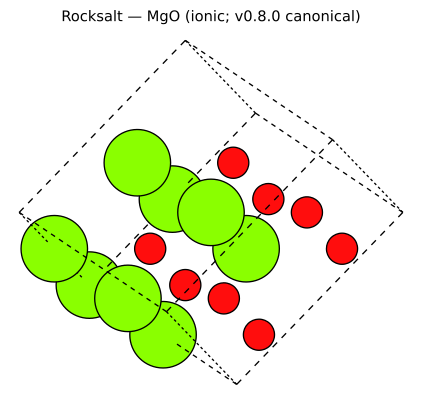
Same FCC primitive lattice, but the second atom sits at \((½,½,½)\), i.e. two interpenetrating FCC lattices offset by half the conventional cube diagonal.
Primitive (FCC):
  a₁ = (a/2)·(0, 1, 1)
  a₂ = (a/2)·(1, 0, 1)
  a₃ = (a/2)·(1, 1, 0)
  Basis: (0, 0, 0), (½, ½, ½)
Real materials (ionic lattice): NaCl (a = 10.65 bohr), KCl, LiF,
MgO, CaO, all the “alkali halide” / “alkaline-earth oxide”
prototypes. The Madelung-constant cross-validation in
examples/periodic/input-madelung-constants.py
runs on rocksalt + zincblende + CsCl.
Worked examples ship under
examples/periodic/MgO-rocksalt/
(canonical; also paired with CRYSTAL14 parity inputs),
examples/periodic/LiH-rocksalt/,
and
examples/periodic/NaCl-rocksalt/.
Each provides RHF + RKS-PBE + RKS-B3LYP variants with pob-TZVP.
The MgO sto-3g RHF example is reproduced inline above.
CsCl (cP + 2-atom basis)
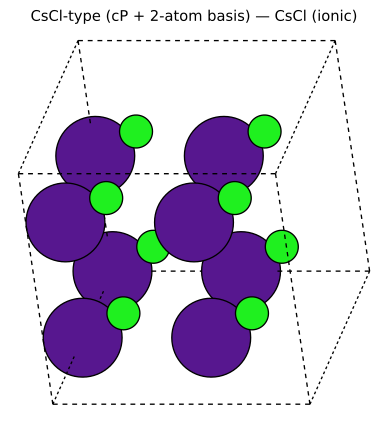
Simple cubic (not BCC!) with one atom at the corner, one at the body center. Distinct from BCC because the two basis atoms are different elements, the center atom isn’t related by translation to the corner atom.
a₁ = (a, 0, 0); a₂ = (0, a, 0); a₃ = (0, 0, a)
Basis: Cs at (0, 0, 0), Cl at (½, ½, ½)
Real materials (ionic): CsCl (a = 7.78 bohr), CsBr, NH₄Cl (high-T), TlBr.
Cubic perovskite (cP + 5-atom basis)
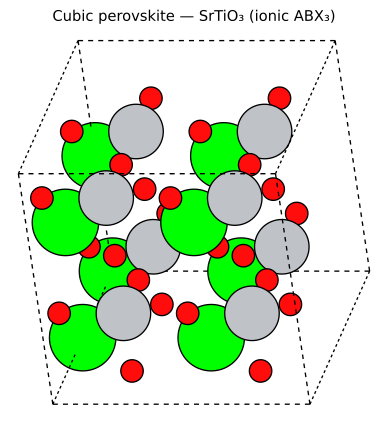
ABX₃, one A cation at the corner, one B cation at the center, three X anions on the face centers.
a₁ = (a, 0, 0); a₂ = (0, a, 0); a₃ = (0, 0, a)
Basis:
  A at (0, 0, 0)        # large cation, e.g. Sr, Ba, Ca
  B at (½, ½, ½)        # small cation, e.g. Ti, Zr, Mn
  X at (½, ½, 0)        # anion
  X at (½, 0, ½)
  X at (0, ½, ½)
Real materials (ionic, ABX₃, class includes both insulators and metallic conductors depending on composition): SrTiO₃, BaTiO₃ (rt cubic), CaTiO₃, KMnF₃ (above the ferro-distortion transition). Ferroelectrics are typically distorted perovskites, the cubic phase is the high-symmetry parent.
Hexagonal family
Simple hexagonal / hP
a₁ = (a, 0, 0)
a₂ = (-a/2, a√3/2, 0)
a₃ = (0, 0, c)

Basis: (0, 0, 0)
Real materials: rare on its own (graphene is hP 2D); most hexagonal solids have a 2-atom basis (HCP) or 4-atom (graphite).
Hexagonal close-packed / HCP (hP + 2-atom basis)
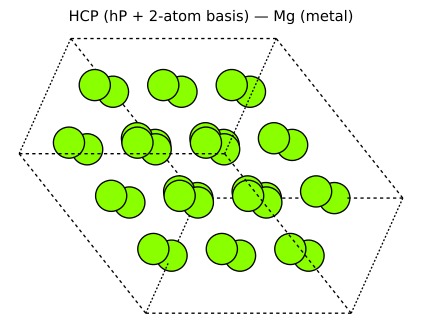
Same lattice vectors as hP.
Basis: (0, 0, 0), (⅓, ⅔, ½)

For ideal HCP:  c/a = sqrt(8/3) ≈ 1.633
Real materials (metals): Mg (c/a = 1.624), Zn (c/a = 1.86, non-ideal), Be, Ti (α-phase), Co (α), Os, Ru. Metal-typical (see the metals note).
Wurtzite (hP + 4-atom basis)
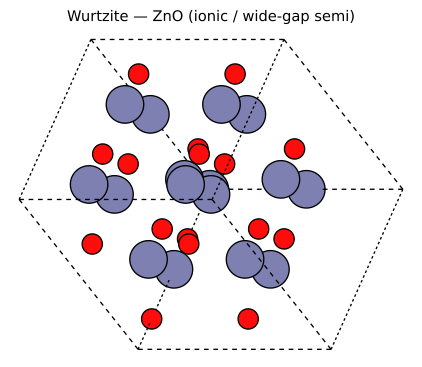
Hexagonal binary structure analogous to zincblende. ABAB stacking of close-packed planes (vs ABCABC for zincblende).
Same lattice vectors as hP.
Basis (X = small atom, Y = large atom):
  X at (0, 0, 0)
  X at (⅓, ⅔, ½)
  Y at (0, 0, u)            # u ≈ 3/8 ideal
  Y at (⅓, ⅔, ½ + u)
Real materials (ionic / wide-gap semiconductors): ZnO, GaN, AlN, CdS, SiC (4H/6H polytypes), BN(h).
Worked example ships under
examples/periodic/ZnO-wurtzite/,
RHF + RKS-PBE + RKS-B3LYP variants with pob-TZVP.
Graphene (2D) and graphite (3D)
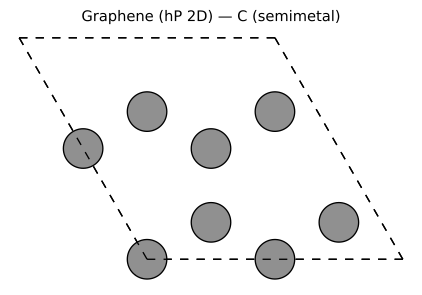
Graphene is a 2D hexagonal lattice with a 2-atom basis (the two
sublattices A and B), a semi-metal. vibe-qc handles 2D systems as
genuine dim=2 slabs. Build one with vq.slab_2d, which takes the two
in-plane lattice vectors and the atoms at their real z. There is no
vacuum gap: the third lattice column is synthesized bookkeeping and the
SCF energy does not depend on it.
a = 4.6487  # bohr (graphene C-C ≈ 1.42 Å → a ≈ 2.46 Å)

# Two in-plane vectors + Cartesian-z atoms (bohr). No third vector.
sysp = vq.slab_2d(
    [a,       0.0,                 0.0],
    [a / 2,   a * np.sqrt(3) / 2,  0.0],
    [vq.Atom(6, [0.0,     0.0,                 0.0]),
     vq.Atom(6, [a / 2,   a * np.sqrt(3) / 6,  0.0])],
)
assert sysp.dim == 2
jk_method="auto" sends this to the vacuum-free SLAB_EWALD_2D gauge.
Passing a bulk route such as jk_method="gdf" raises.
Graphite is graphene stacked along \(c\) with AB Bernal stacking; 4-atom basis.
Tetragonal, orthorhombic, monoclinic, triclinic
These cover lower-symmetry structures: distorted perovskites, elemental tin (β-Sn is tI), molecular crystals (most are monoclinic or triclinic), high-Tc superconductors (oC, oI).
vibe-qc accepts arbitrary lattice vectors, so any of these works
out of the box. For symmetry analysis, attach_symmetry(sysp)
runs spglib and returns the space group regardless of which
crystal-system label you’d pick by eye.
Rutile (tP / P4₂/mnm), TiO₂
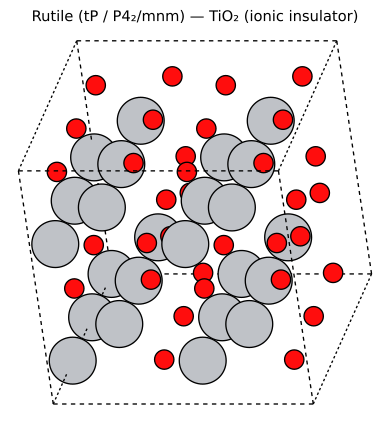
The canonical tetragonal ionic insulator: 6-atom unit cell, two Ti at \((0,0,0)\) and \((½,½,½)\), four O at \(\pm(u, u, 0)\) and \(\pm(½ + u, ½ - u, ½)\) with \(u ≈ 0.305\).
Real materials (ionic, wide-gap insulator / transition-metal oxide): TiO₂-rutile, MgF₂, SnO₂, RuO₂ (metallic), IrO₂ (metallic). The rutile structure type covers both wide-gap insulators (TiO₂) and metallic conductors (RuO₂); the lattice geometry is the same, the electronic-structure regime is different.
Worked example ships under
examples/periodic/TiO2-rutile/,
RHF + RKS-PBE + RKS-B3LYP with pob-TZVP.
Corundum (hR / R-3c), α-Al₂O₃
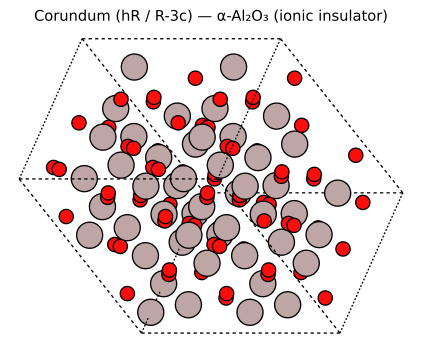
Trigonal (rhombohedral). Both the hexagonal-settings (30-atom) and rhombohedral-primitive (10-atom) conventions work in vibe-qc.
Real materials (ionic / wide-gap insulator): α-Al₂O₃ (sapphire), Cr₂O₃, Fe₂O₃ (hematite), V₂O₃, Ti₂O₃. Sapphire is the canonical example; the M₂O₃ family includes both insulators (Al₂O₃, Cr₂O₃) and Mott-Hubbard insulators / metals (V₂O₃, Ti₂O₃).
Worked example ships under
examples/periodic/Al2O3-corundum/,
sto-3g RHF (provenance + smoke test).
α-Quartz (hP / P3₂21), SiO₂
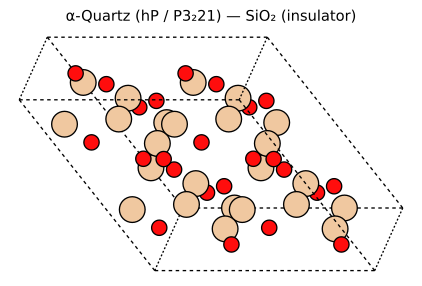
Trigonal SiO₂; 9-atom unit cell (3 SiO₂ formula units). Two helical handednesses (α-quartz is chiral: P3₂21 left-handed, P3₁21 right-handed); both spgroups occur naturally.
Real materials (ionic / wide-gap insulator): SiO₂ in its α-quartz polymorph is the most common natural form.
Worked example ships under
examples/periodic/SiO2-alpha-quartz/,
RHF + RKS-PBE + RKS-B3LYP with pob-TZVP.
Primitive vs conventional cells
The primitive cell is the smallest cell that tiles all of space under lattice translations. For BCC + FCC lattices, the primitive cell is not the cubic cell most textbooks draw, it’s a rhombohedron half the volume (BCC) or quarter the volume (FCC).
You’d think you always want the primitive cell, fewer atoms = faster SCF. Two reasons to use the conventional cell instead:
Symmetry. Cubic cells make x, y, z directions explicit. The k-mesh is naturally aligned to the conventional cell’s axes; band paths are conventionally specified in conventional-cell coordinates (Γ, X, M, R, K).
Multi-atom bases. Diamond, NaCl, etc. need 2-atom bases on the FCC primitive cell. Some users find it easier to build the conventional cell with a multi-atom basis (4 + 4 = 8 atoms for diamond) than to set up the primitive cell + 2-atom basis. The energy is identical; the multi-k cost is roughly 4× higher for the same physical system.
vibe-qc respects whichever cell you build. Use detect_spacegroup
for non-mutating inspection, attach_symmetry when downstream
k-point / integral code should see system.symmetry, and
symmetrise when an imported structure should be standardised before
calculation:
import vibeqc as vq

sg = vq.detect_spacegroup(sysp, symprec=1e-4)
print(f"Space group: {sg.international_symbol} (#{sg.number})")
print(f"Hall number: {sg.hall_number}")
print(f"#operations: {sg.order}")

standard = vq.symmetrise(sysp, symprec=1e-4)
sysp_clean = standard.system
print(f"RMS cleanup: {standard.report.rms_displacement_bohr:.3e} bohr")

primitive = vq.symmetrise(sysp, symprec=1e-4, to_primitive=True).system
The reciprocal lattice and the Brillouin zone
For lattice vectors \(\mathbf{a}_1, \mathbf{a}_2, \mathbf{a}_3\), the reciprocal lattice is generated by
with \(V = \mathbf{a}_1 \cdot (\mathbf{a}_2 \times \mathbf{a}_3)\) the unit-cell volume. A general reciprocal-lattice vector is
The first Brillouin zone (BZ) is the Wigner-Seitz cell of the reciprocal lattice, the set of \(\mathbf{k}\) closer to \(\mathbf{G}=0\) than to any other reciprocal-lattice point. Bloch’s theorem (F. Bloch, Z. Phys. 52, 555 (1929), doi:10.1007/BF01339455) says every electronic state in a periodic crystal can be labeled by a \(\mathbf{k}\) in this region.
The BZ shape depends on the Bravais lattice:
Real-space lattice |
BZ shape |
|---|---|
Simple cubic (cP) |
Cube |
BCC (cI) |
Rhombic dodecahedron |
FCC (cF) |
Truncated octahedron |
Hexagonal (hP) |
Hexagonal prism |
Trigonal (hR) |
Depends on the rhombohedral angle (Setyawan-Curtarolo RHL1 for α < 90°, RHL2 for α > 90°) |
vibe-qc doesn’t currently provide a BZ-shape visualization tool; external packages like seekpath (Hinuma, Yoyo, Pizzi, Giovanni, et al. (2017). *Band structure diagram paths based on crystallography.* Computational Materials Science, **128**, 140–184. doi:[10.1016/j.commatsci.2016.10.015](https://doi.org/10.1016/j.commatsci.2016.10.015)) or pymatgen do this well.
High-symmetry points
These are the special \(\mathbf{k}\)-points where the BZ has extra symmetry. Band structures conventionally trace a path through them. The Setyawan-Curtarolo (2010) convention (W. Setyawan, S. Curtarolo, Comput. Mater. Sci. 49, 299 (2010), doi:10.1016/j.commatsci.2010.05.010) is what almost everyone uses today:
BZ shape |
High-symmetry points |
|---|---|
Cube (cP) |
Γ, X, M, R |
Rhombic dodecahedron (cI / BCC) |
Γ, H, N, P |
Truncated octahedron (cF / FCC) |
Γ, X, K, L, U, W |
Hexagonal prism (hP) |
Γ, M, K, A, L, H |
The \(\Gamma\) point is always at the BZ center, \(\mathbf{k} = (0,0,0)\) in any units. Other points are at half- or quarter-cell positions in reciprocal space.
For example, on FCC (fractions of the primitive reciprocal vectors \(\mathbf{b}_1, \mathbf{b}_2, \mathbf{b}_3\), Setyawan-Curtarolo convention):
Γ  =  (0,    0,    0   )         # BZ centre
X  =  (½,    0,    ½   )         # centre of a square face
L  =  (½,    ½,    ½   )         # centre of a hexagonal face
K  =  (3/8,  3/8,  3/4 )         # midpoint of an edge shared by two hexagonal faces
W  =  (½,    ¼,    ¾   )         # corner of square face
The standard FCC band path is Γ → X → W → K → Γ → L → U → W → L → K, which traces all of the BZ’s irreducible piece.
Setting up lattices in vibe-qc
Tip
For any non-trivial structure, import from a CIF / POSCAR file rather than typing lattice vectors by hand. Vibe-qc reads:
read_cif(path)/Crystal.from_cif(path)— Crystallographic Information File (the standard format for published structures); passsymmetrise=Truefor a standardisedPeriodicSystem.read_poscar(path)— VASP 5 POSCAR; passsymmetrise=Trueto return aSymmetriseResultwith a standardisedPeriodicSystem.from_xyz(path, periodic=True)— Extended-XYZ with aLattice="..."comment tag; passsymmetrise=Truefor the same standardisation pipeline.
The Materials Project (https://materialsproject.org/), Crystallography Open Database (https://crystallography.net/cod/), and ICSD (commercial) all export CIF directly.
For test systems and small examples, building by hand is straightforward:
import numpy as np
import vibeqc as vq

# --- FCC primitive (Cu, a = 3.61 Å) -----------------------------
a = 6.82  # bohr
fcc_primitive = (a / 2) * np.array([
    [0, 1, 1],
    [1, 0, 1],
    [1, 1, 0],
])
cu_fcc = vq.PeriodicSystem(
    dim=3, lattice=fcc_primitive,
    unit_cell=[vq.Atom(29, [0, 0, 0])],
)

# --- Diamond (Si, a = 5.43 Å) -----------------------------------
a = 10.26  # bohr
si_diamond = vq.PeriodicSystem(
    dim=3, lattice=(a / 2) * np.array([
        [0, 1, 1], [1, 0, 1], [1, 1, 0],
    ]),
    unit_cell=[
        vq.Atom(14, [0.00, 0.00, 0.00]),
        vq.Atom(14, [a / 4, a / 4, a / 4]),     # Cartesian bohr
    ],
)

# --- Rocksalt (NaCl, a = 5.64 Å) --------------------------------
a = 10.65  # bohr
nacl = vq.PeriodicSystem(
    dim=3, lattice=(a / 2) * np.array([
        [0, 1, 1], [1, 0, 1], [1, 1, 0],
    ]),
    unit_cell=[
        vq.Atom(11, [0.0, 0.0, 0.0]),
        vq.Atom(17, [a / 2, a / 2, a / 2]),     # Cartesian bohr
    ],
)

# --- Hexagonal close packed (Mg, a = 3.21 Å, c = 5.21 Å) --------
a, c = 6.06, 9.85   # bohr
mg_hcp = vq.PeriodicSystem(
    dim=3, lattice_vectors=[           # one vector per row; not lattice=
        [a,    0.0,                 0.0],
        [-a/2, a * np.sqrt(3) / 2,  0.0],
        [0.0,  0.0,                 c  ],
    ],
    unit_cell=[
        vq.Atom(12, [0.0,  0.0,              0.0]),
        vq.Atom(12, [0.0,  a / np.sqrt(3),   c / 2]),   # fractional (1/3, 2/3, 1/2)
    ],
)
What’s next
For how vibe-qc samples the BZ of any of these lattices, Monkhorst-Pack meshes, Γ-only vs Γ-centered, IBZ reduction, mesh convergence, k-paths for band structures, see k-point meshes.
For how to run a periodic SCF on one of these lattices, EWALD_3D Coulomb dispatch, periodic Becke partition for DFT, level shifts and smearing for SCF stability, see Ewald summation and SCF convergence.
For band-structure plots along the high-symmetry paths above, see band structure and band structure of an H-chain.
For symmetry exploitation in periodic SCF (compressing the lattice-matrix set under the space group), see symmetry-aware periodic storage.
References
M. I. Aroyo, ed., International Tables for Crystallography, Vol. A, “Space-Group Symmetry” (8th ed., Wiley, 2024), the authoritative reference for space groups, Wyckoff positions, and crystallographic conventions.
W. Setyawan and S. Curtarolo, “High-throughput electronic band structure calculations: Challenges and tools,” Comput. Mater. Sci. 49, 299 (2010), defines the Bravais-lattice-specific k-paths used today.
C. Bradley and A. Cracknell, The Mathematical Theory of Symmetry in Solids (Oxford, 1972), the textbook reference for space-group representations.
Spglib documentation, https://spglib.readthedocs.io/, the symmetry-finder vibe-qc uses internally; particularly the “Definition of unit cell” page on conventions.
See also
periodic_methods.md: comparative tour of the periodic-SCF kernels (BIPOLE, GDF, GPW/GAPW) the Bravais lattices feed into, bonding-organised example gallery, and the surface-reactions workflow.